Spanish online shops could cut the weight of their images in half
An Airpic study of 296 Spanish online shops and 9,620 homepage images. October 2026.
Key findings
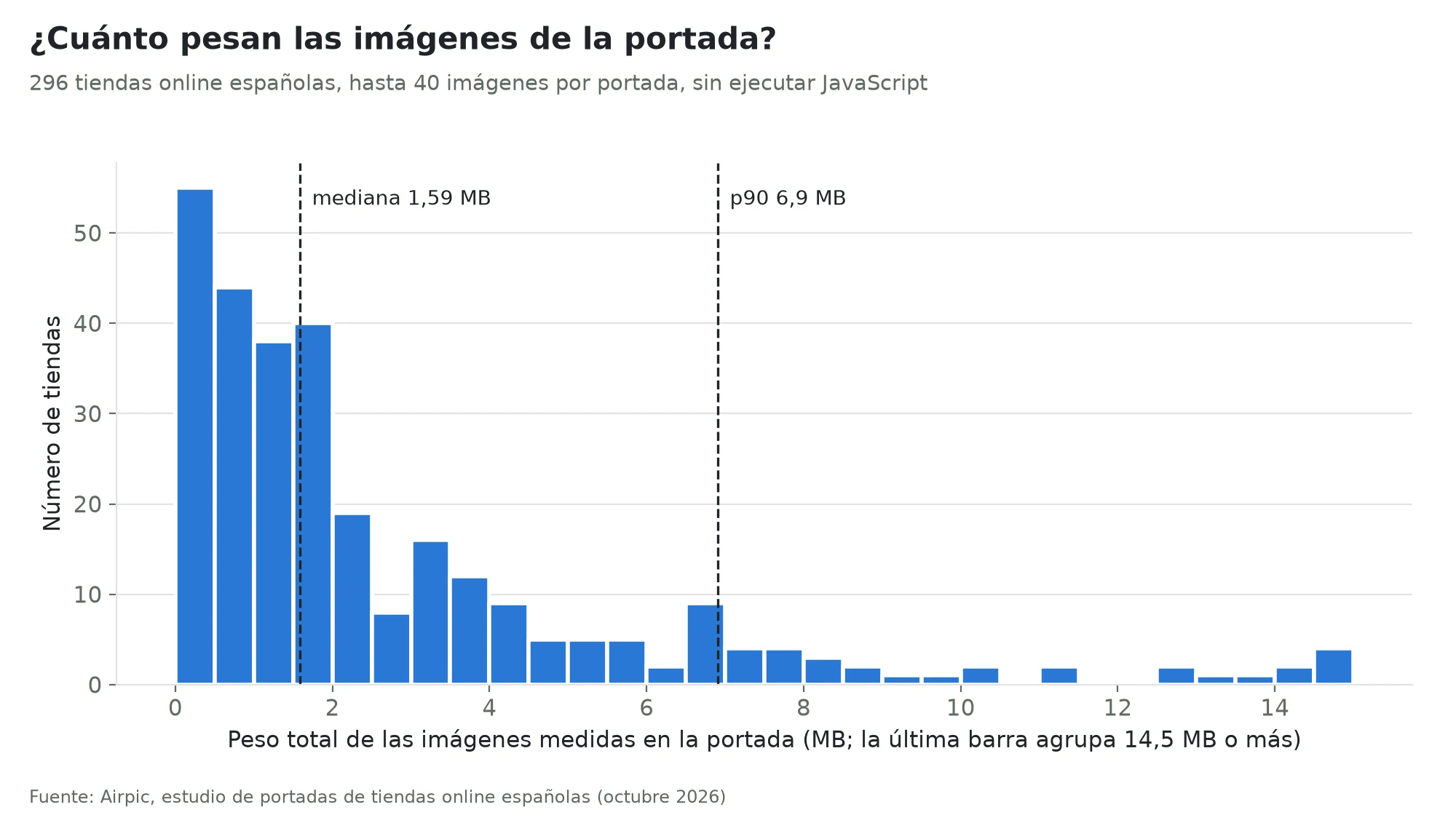
- 1.59 MB of images on the median shop's homepage, counting only the first 40 images. One in ten shops exceeds 6.9 MB and 50 shops (17%) go over 5 MB.
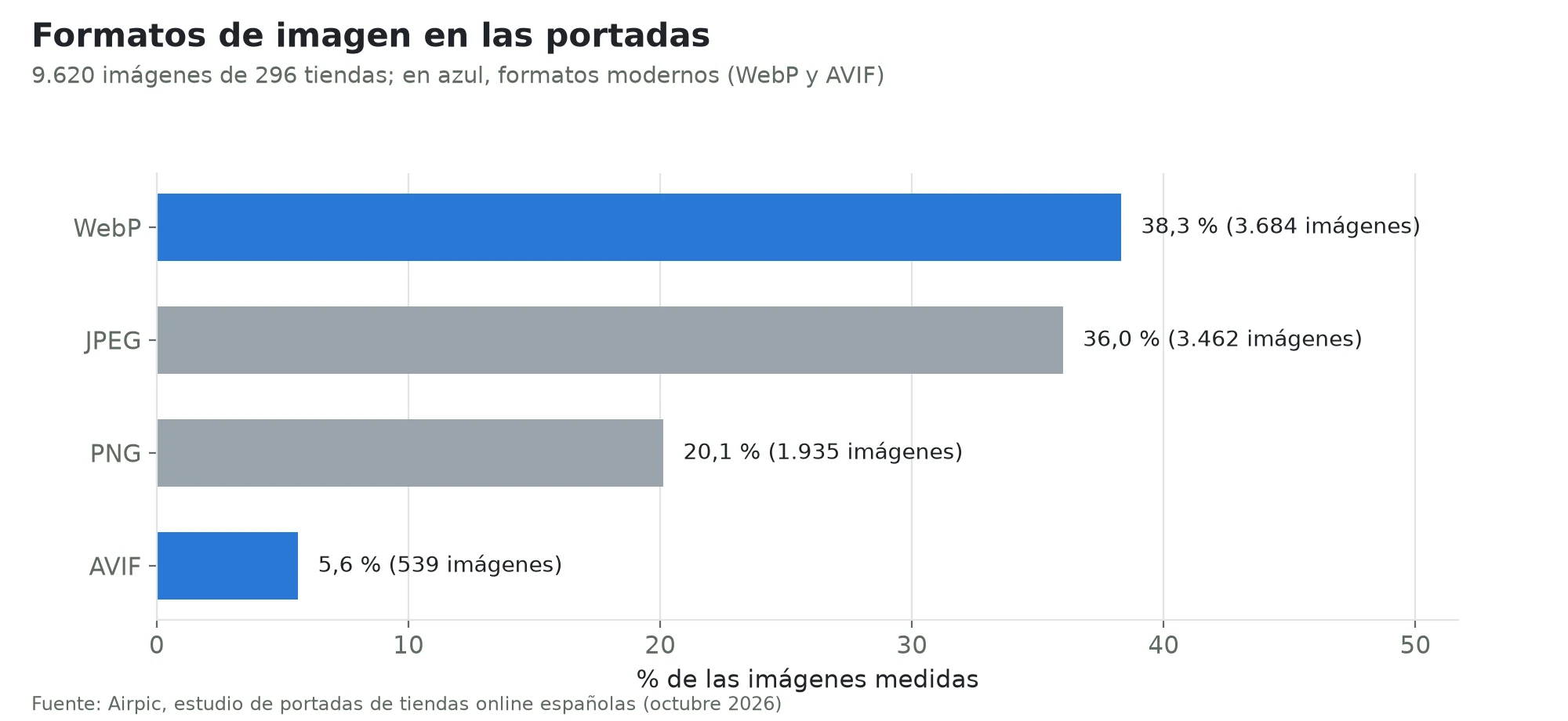
- 56% of images are still JPEG or PNG, and they account for 73% of the bytes. 112 shops (38%) serve not a single WebP or AVIF image.
- With AVIF, total image weight would drop by 58%; with WebP, by 55%. The median shop would save 52% (0.57 MB per homepage visit) and 152 shops (51%) could cut half or more.
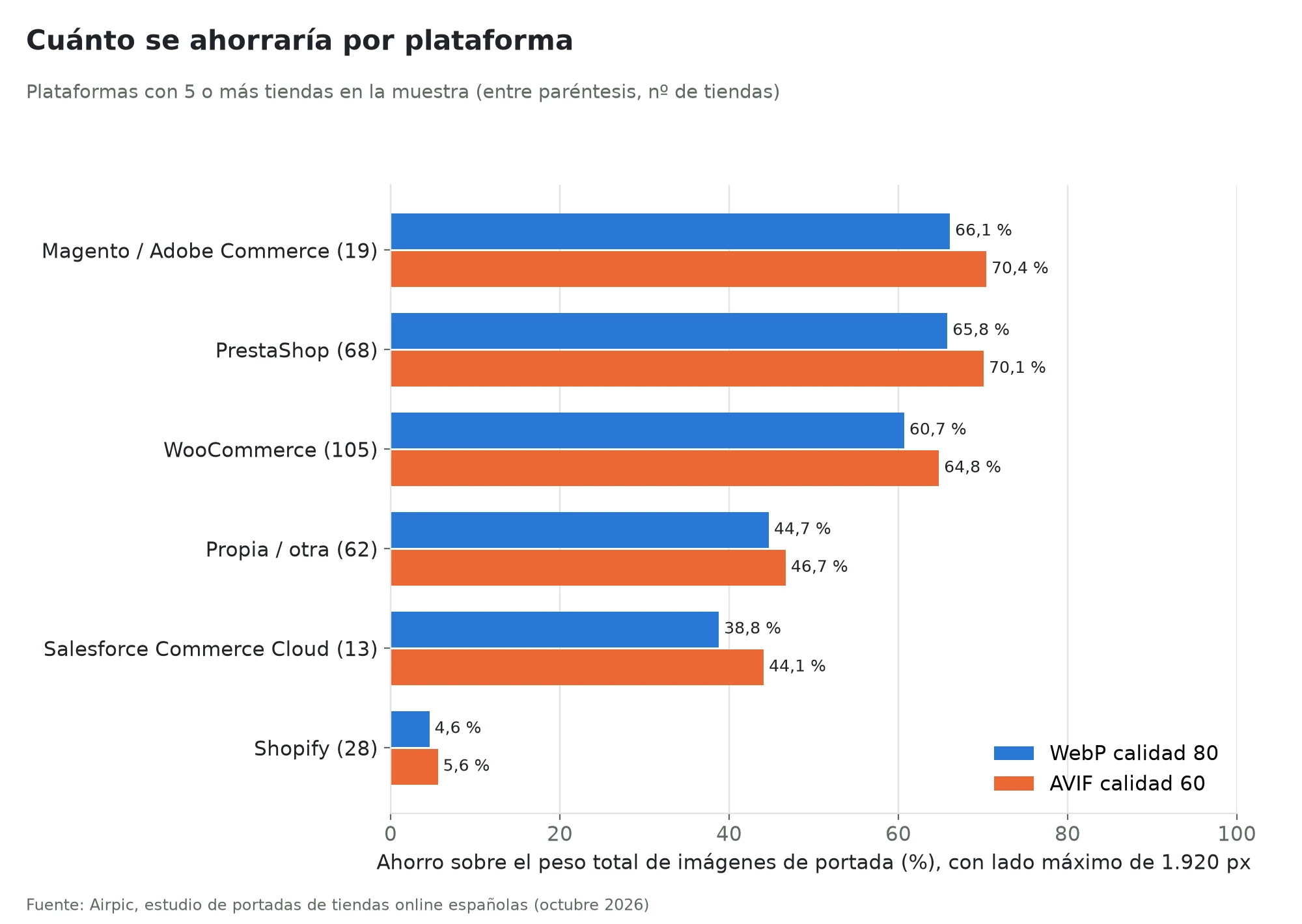
- The platform makes the difference: on Shopify, 90% of images already arrive in a modern format and the remaining margin is 6%; on PrestaShop, Magento and WooCommerce the possible saving ranges from 65% to 70%.
- 106 images over 1 MB across 46 shops, and 27 images over 4,000 pixels on the long side across 17 shops. The heaviest, a 4,320 × 1,080 px PNG, weighs 10.6 MB.
More than half of the images still use formats from three decades ago
Of the 9,620 images measured, 5,397 are JPEG or PNG and make up 73% of all downloaded bytes. WebP and AVIF, which every current browser supports, already represent 44% of the images but only 27% of the weight: the bulk of the bytes still travels in older formats. In 112 of the 296 shops, not one modern-format image appeared.
A 1.6 MB homepage in images, with a long and heavy tail
The median shop downloads 1.59 MB of images on its homepage, counting at most 40 images and without running JavaScript, so the real figure is the same or higher. The distribution has a long tail: 25% of shops exceed 3.6 MB and 10% exceed 6.9 MB. As pure transfer over a 10 Mbps 4G connection, 1.59 MB is about 1.3 seconds of images alone.
Switching to AVIF or WebP would halve the weight
Re-encoding every JPEG and PNG to AVIF (quality 60) or WebP (quality 80) and capping the long side at 1,920 pixels, the total image weight of the 296 homepages would fall from 825 MB to 345 MB with AVIF (58% less) or to 374 MB with WebP (55% less). Looking only at the JPEG and PNG images, the cut is 79% with AVIF and 75% with WebP. For the median shop the saving is 52% with AVIF, 0.57 MB per homepage visit. In practice, under the assumptions stated in the methodology, that is about 0.46 seconds of transfer over 4G for the median shop and 3.6 seconds for the 10% of shops with the most room to improve. For every 10,000 uncached homepage visits, the median shop would serve 5.7 GB less; the top 10%, 44.8 GB or more.
The platform matters more than the shop
Shops on Shopify serve 90% of their images as WebP or AVIF because its CDN picks the format according to the browser; the remaining margin is 6%. On PrestaShop (68 shops), Magento/Adobe Commerce (19) and WooCommerce (105), fewer than a third of the images are modern and the possible saving is 70%, 70% and 65% respectively. Shops on in-house platforms and on Salesforce Commerce Cloud sit in between, at 47% and 44%.
Images larger than the screen
There are 353 images wider or taller than 1,920 pixels, more than almost any banner occupies on screen, and 27 exceed 4,000 pixels, a size typical of a photo or design uploaded without resizing. 106 images weigh more than 1 MB each. Six of the eight heaviest images in the sample are PNG, a format designed for graphics and transparency that multiplies the weight when used for photos or banners.
Methodology in brief
Sample: the 300 online shops with a .es domain ranked highest in the Tranco list of 18 October 2026 (1,200 .es domains passed the e-commerce filter: a shop platform detected or clear cart and product signals). Images were measured on 296 of them. Data collected on 19 October 2026 simulating a 1,440 px browser, without running JavaScript, respecting robots.txt, up to 40 images per homepage (including lazy-loaded data-src images). Each JPEG and PNG was re-encoded locally to WebP quality 80 and AVIF quality 60 (Pillow and libavif, speed 6), with and without a 1,920 px cap; a negative saving is never counted. Images already in WebP or AVIF count as zero saving. Limitations: homepage only, no JavaScript, at most 40 images (188 shops had more), a single measurement. Full methodology, scripts and aggregated data are available.
How to improve it
- Serve WebP or AVIF: many platforms have a module or CDN that does it automatically based on the browser.
- Resize before uploading: a banner rarely needs more than 1,920 px in width, and a thumbnail far less.
- Keep PNG for logos and graphics with transparency; photos in JPEG, WebP or AVIF.
- Use `srcset` and `sizes` so phones do not download the desktop image.
- For individual images, free tools such as Airpic's Compress image convert to WebP or AVIF and cap the size without installing anything.
*Study by Airpic (airpic.app). Data collected on 19 October 2026.*